Libby Jenke

I am a quantitative methodologist specializing in causal inference and experimental methods. My work uses eye tracking to obtain direct measures of decision processes, information accrual, and attention. Substantively, I study questions of voter behavior, with an emphasis on affective polarization. I am currently a Quantitative UX Researcher at Meta.

Odd Profiles in Conjoint Experimental Designs: Effects on Survey-Taking Attention and Behavior featured image

Odd Profiles in Conjoint Experimental Designs: Effects on Survey-Taking Attention and Behavior

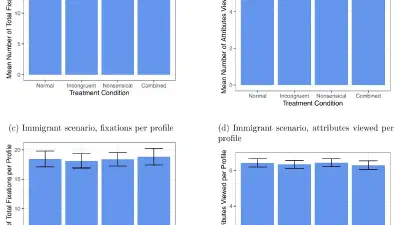
Odd attribute combinations in conjoint tables don't meaningfully affect respondents' attention or choices.

Kirk Bansak
Affective Polarization and Misinformation Belief featured image

Affective Polarization and Misinformation Belief

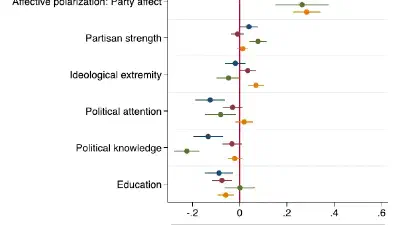
Rising affective polarization increases belief in misinformation that favors your own party — and decreases belief in misinformation that favors the other side.

avatar
Libby Jenke

Eye Tracking Preregistration Template

A preregistration template for eye-tracking studies, developed with the Center for Open Science, covering calibration, preprocessing, area-of-interest construction, and …

avatar
Libby Jenke
Using Eye-Tracking to Understand Decision-Making in Conjoint Experiments featured image

Using Eye-Tracking to Understand Decision-Making in Conjoint Experiments

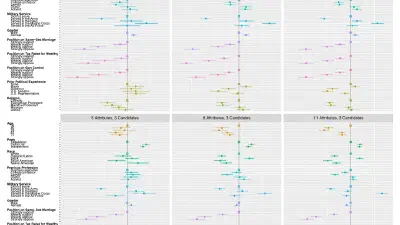
As conjoint tables grow more complex, respondents selectively adjust their attention while their choices stay remarkably stable.

avatar
Libby Jenke